
Documents Inside Baltimore County Deed Records
Instruments enter Baltimore County deed records through the Clerk of the Circuit Court, the county's recording custodian for conveyances. That office files each deed into the land records. A deed names its parties, states the consideration, and carries the legal description along with execution and recording details, while related instruments such as mortgages, releases, and easements document the financing and later changes around it.
| Deed Type | What It Does | Common Use |
|---|---|---|
| Warranty deed | Conveys the stated estate with deed warranties. | Ordinary purchase transfer where warranties are given. |
| Quitclaim deed | Conveys whatever interest the grantor holds without promising its extent. | Interest cleanup and transfers among related parties. |
| Trustee or fiduciary deed | Conveys under stated trust, estate, or court authority. | Trust, probate, or authorized sale. |
| Foreclosure-related deed | Documents a transfer following the applicable court process. | Distressed-property chain after sale and ratification. |
| Easement or release | Creates, changes, or releases a recorded right or encumbrance. | Access, utility, mortgage, or title research. |
A mortgage or deed of trust secures a debt. It never replaces the vesting deed. A release is its own separate instrument, so locating a mortgage alone proves nothing about whether it still binds the parcel. Tax liens and judgments are not all held in MDLandRec either, and a UCC search is not a substitute for land-record lien research.
Use SDAT as Baltimore County's Deed Bridge
The SDAT Real Property Search offers the fastest bridge into the deed books. Its assessment result shows the liber and folio tied to the last recorded deed. Search it by address, street, account identifier, or map reference. Owner-name searches are not accepted. Copy the premises address, the account number or PAN, and the legal description. Copy the sale fields and the deed reference before moving on. Take that book and page to MDLandRec through its book/page jump. Clerk selection can also be available. The reference only points to the instrument. The image itself reveals the full legal description, the vesting language, and the execution details. It also shows the prior references that continue the chain. Note: SDAT labels its owner field as the name on the last recorded deed, but it remains an assessment roll, not a title opinion.
Search the Baltimore County Land Index by Party
MDLandRec's name form goes well beyond exact surnames. Its fields help separate people, organizations, fiduciaries, and spelling variants in Baltimore County deed records.
| Index field | Options or format | Research use |
|---|---|---|
| Corporation or last name | Is, Begins With, Ends With, Contains, Fuzzy, Soundex | Try exact and variant spellings. |
| Given-name detail | First, middle, suffix | Separate parties with similar names. |
| Legal capacity | Capacity notation | Find trustee, executor, or guardian roles. |
| Ownership and party type | Corporation/individual; grantor/grantee/all | Control the direction of the chain. |
| Instrument and remarks | Contains modifiers | Narrow to a deed type or indexed notation. |
| Cross-reference and dates | Book/page; all dates or range | Connect related documents and periods. |
The Baltimore County land index works through MDLandRec, a state-run deed records system. Some entries link straight to an electronic image. Others show only the index line at first, because images follow indexing. The help guidance says images usually post quickly. They appear one or two business days after a book is verified. Before relying on coverage, check the portal's "Data Verified Through" date. The current MDLandRec access page displays the remote login and account gate.
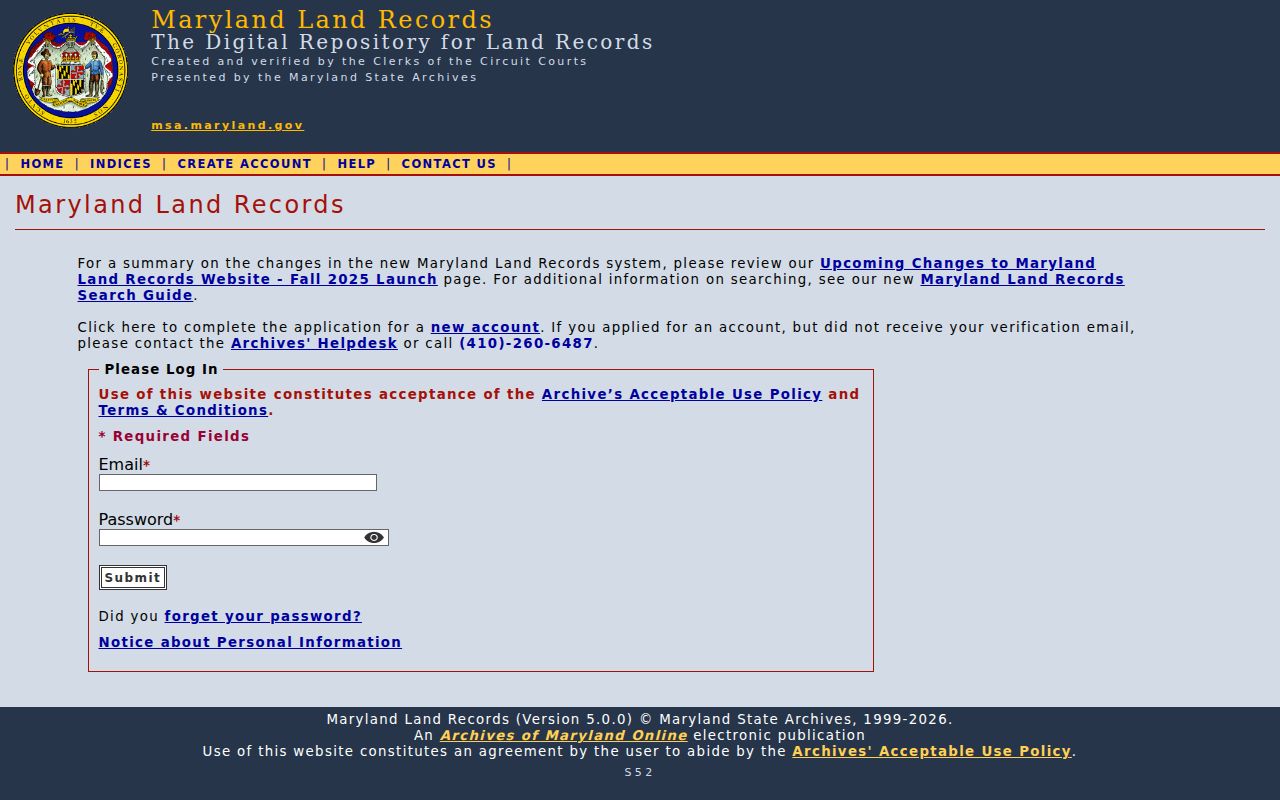
This screen opens the electronic index and image tools. It does not replace the free public workstations available onsite.
Walk Baltimore County's Grantor-Grantee Chain
Build the chain by alternating deed and index. Start from a parcel identified through SDAT. That anchor lets you test same-name search results against a single legal description as you walk the grantor-grantee sequence backward.
- Open the latest vesting deed and record its grantee, grantor, recording date, deed type, book/page, and legal description.
- Read any prior-deed or “being the same” reference and open that instrument directly when possible.
- Search the current grantor as a grantee in the earlier period, trying Fuzzy or Soundex and legal-capacity variants.
- Repeat while reconciling every transfer to the parcel, plat, lot, tract, and adjoining-owner clues.
- Move to Archives indexes, deed books, and microfilm when the electronic trail stops.
- Grantor
- The party conveying the stated interest.
- Grantee
- The party receiving the stated interest.
- Chain of title
- The ordered sequence of conveyances associated with the same land.
- Book and page
- The liber/folio locator used to retrieve a recorded Baltimore County instrument.
Baltimore County Land Books Reach into the 1600s
The Maryland State Archives land-series guide traces Baltimore County land material back to 1659/1661. Deed books run through 1851. Index and finding-aid series reach later, some through 1921. The archives does not state where the modern live electronic county index begins, so treat that cutoff as an open question rather than a guess. Older research often calls for grantee, grantor, and tract indexes, deed books, or microfilm, and early instruments lean on tract names, adjoining owners, roads, plats, and metes-and-bounds calls. For plats, Baltimore County PLATS.NET searches by book and page, plat or box number, date, description, and series controls. A subdivision plat can anchor a description quickly. A right-of-way plat works the same way. East Towson's African-American landholding, documented from an 1853 purchase, shows why this depth matters. Deeds and plats can reveal how a neighborhood formed. A present assessment card cannot. Library newspapers and directories can add occupant and street context around a property, but they never replace the conveyance itself.
Remote Images and Free Baltimore County Workstations
The Fall 2025 MDLandRec release changed remote accounts and page-image access. One account now ties to one email, and previous users may need to register again. Remote page images are purchased. The release facts describe a 30-day access period before repurchase. Confirm current pricing in the live system. Older instructions can mislead. Free viewing survives elsewhere. Maryland State Archives searchroom workstations offer official access at no charge. County courthouses and law libraries do the same. Remote access saves travel but sits behind an account and payment gate. Onsite work is free. It demands a visit, though, and may warrant a call ahead for an older volume.
| Remote MDLandRec | Account required; index and purchased image access; limited purchased-page period. |
|---|---|
| Courthouse or Archives | Free public workstation access; staff can route copy and archived-volume questions. |
Verify a Suspicious Baltimore County Deed
Deed fraud has a state-level answer. The Maryland Insurance Administration deed-fraud advisory recommends monitoring MDLandRec and obtaining copies from the county clerk. It also says to report a suspicious filing to local law enforcement, a lender or title insurer, and the Maryland Attorney General, and it notes a state task force convening in 2026 with a report due July 1, 2028. Save the index result and the image. Compare grantor, grantee, notary, consideration, legal description, and prior book and page, then call the land-indexing or recording desk. Baltimore County runs no official alert-enrollment service. A statewide advisory is not a county signup program.
Obtain a Baltimore County Deed Copy
The Baltimore County Circuit Court clerk keeps recorded land instruments for the county. The Land Recording desk answers at 410-887-2651, and Land Indexing is 410-887-3088. The counter sits on the second floor of the County Courts Building. The address is 401 Bosley Avenue in Towson. Walk-in service runs weekdays from 8:30 a.m. to 4:30 p.m. Bring the book and page, party names, recording date, and a property description. Or have them ready when you call. Remote users can pull deed images through MDLandRec instead. Public terminals at the courthouse support in-person retrieval as well. Ask the clerk about mail service, certification, and archived volumes before ordering. Maryland's general court copy rate is $0.50 per page, and certification adds a separate fee.
Recorded, not guaranteed. Baltimore County deed records show what was accepted and indexed, not a title opinion. Unrecorded interests and separate court, tax, or lien records may still matter.
Older deed research takes patience. Archives books and microfilm hold the historical depth that modern indexes lack. Baltimore County Public Library newspapers and directories can add useful context around a parcel. They support rather than replace the land records themselves.
A narrow Maryland Public Information Act request is one more avenue. It covers non-online county administrative material. It cannot create a deed, though. Nor can it stand in for the clerk's record. It also cannot compel the custodian to perform legal research.