
Fields in Baltimore County Property Tax Records
SDAT and Baltimore County Budget and Finance each keep part of the property tax record. The coverage table below helps keep assessment fields and bill fields straight.
| Field | What It Shows | Where |
|---|---|---|
| Land, improvements, total | Separate components and total assessment. | SDAT parcel result |
| Assessment year and phase-in | Cycle year and taxable phase-in amount. | SDAT parcel result |
| Residence and credit flags | Principal-residence, Homestead, and Homeowners' Tax Credit indicators. | SDAT parcel result |
| Bill number, date, and status | The county's bill identity and current payment standing. | County tax portal |
| Charges, fees, credits, schedule | County/state charges, adjustments, and payment timing. | County tax bill |
| Delinquency and tax sale | Current collection status and active sale process. | Tax portal and tax-sale page |
Deed consideration is what the sale recorded. The SDAT assessment is the value that drives tax administration. Neither figure equals the amount due. The county builds the actual bill by applying rates, charges, phase-in, exemptions, and credits to the taxable base.
Read Baltimore County's SDAT Value Fields
Open the SDAT Real Property Search and pick Baltimore County. Search by address, street, account identifier, or map reference. Results can include land and improvement values, the total, assessment year, phase-in amount, sale details, land use, the legal description, and tax-credit status.
Assessment: the value recorded for property-tax administration. Phase-in: the portion brought into the taxable calculation over the cycle. Homestead or homeowner credit: a status or program field. It depends on eligibility and application rules. Tax lien: a legal claim from unpaid tax, not just a balance on a screen.
SDAT's glossary describes the assessment-to-tax relationship plainly. Take the phase-in assessment, divide by 100, and multiply by the applicable rate. That formula explains the math. It does not license an official estimate without current rates, charges, credits, and the county record.
Sale fields deserve equal care. SDAT defines the sale date as the deed's recording date and the price as deed consideration. Transfers carry labels such as arms-length improved, arms-length multiple accounts, arms-length unimproved, or non-arms-length other. A family transfer, estate conveyance, or multi-parcel deal may compare poorly in an appeal. Record the transfer type and legal reference first. Then judge whether a price reflects market value.
Baltimore County's Three Reassessment Areas
Maryland appraises real property on a three-year cycle. The Baltimore County reassessment page splits the county into Areas 1, 2, and 3, with effective dates of January 1, 2025, 2023, and 2024 respectively. Remember, the cycle governs valuation timing only. Deed and owner updates happen on their own schedule.
The local Supervisor of Assessments sits at Hampton Plaza, 300 East Joppa Road, Suite 602, Towson, reachable at 410-512-4900, weekdays from 8:00 a.m. to 4:30 p.m. That office handles assessment notices, worksheets, address changes, and value questions.
Note: A parcel's reassessment area and notice date set its review context; a countywide headline is no substitute for the individual record.
Look Up a Baltimore County Tax Bill
A Baltimore County tax bill lookup starts with either the parcel number or the street address. Either path works. The SDAT account number and premises fields narrow the match, which helps on streets that share a name and keeps an owner mailing address from pulling up the wrong parcel.
- Find the parcel in SDAT and save the account, premises address, and owner mailing address.
- Open the county tax portal and enter Parcel ID when available; otherwise use the street address.
- Match parcel, district, situs, and owner mailing information before reading the bill.
- Review bill number, date, status, county/state charges, fees, exemptions, credits, and payment schedule.
- Confirm any delinquency or tax-sale conclusion in the current county system.
Start a real-property lookup and payment screen search to pull up any Baltimore County tax bill.
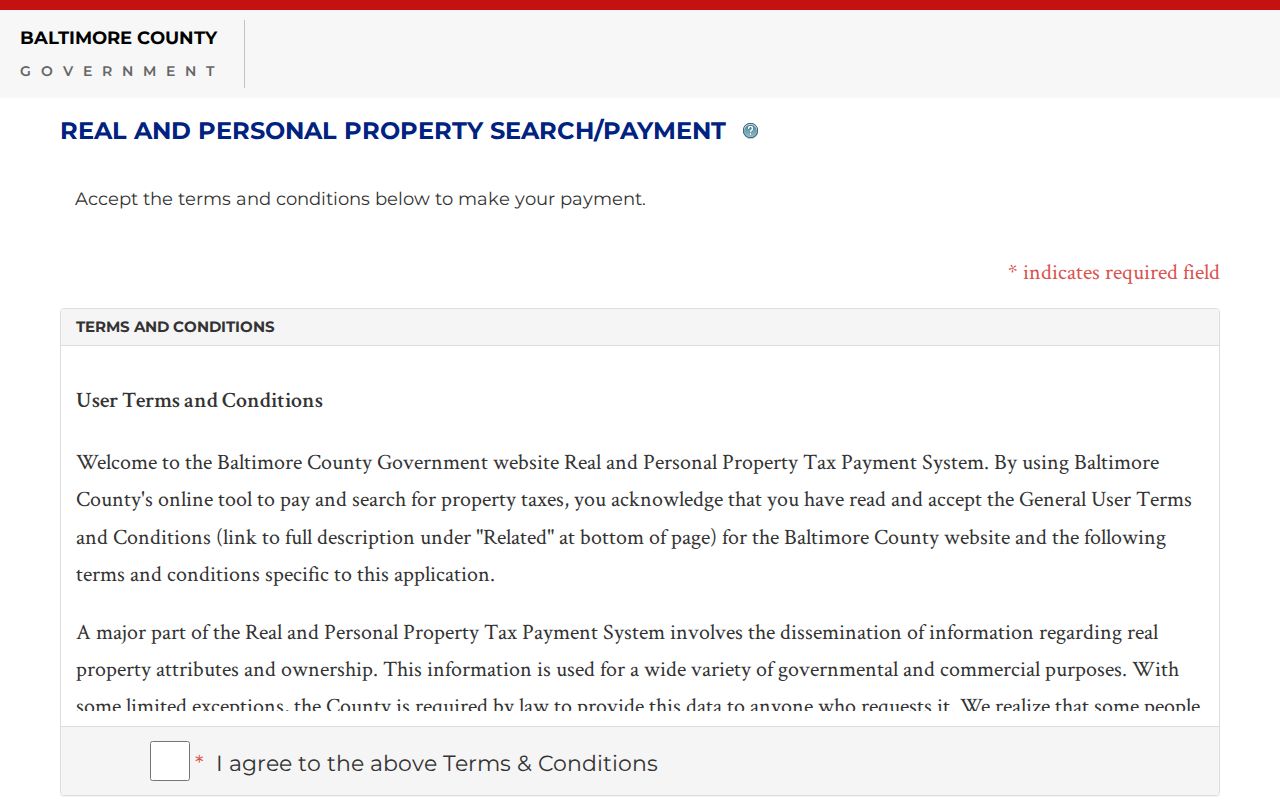
This landing screen only opens the door. Exact status and amounts come from a live parcel query. Published payment charges include a $0.95 e-check convenience fee, a 2.39 percent card fee, and a $35 returned-check charge.
Credits That Change a Baltimore County Bill
The Homeowners' Property Tax Credit program hinges on principal-residence and eligibility rules, and the official guidance covers heir documentation plus a Baltimore County supplemental credit. Homestead and Homeowners' Tax Credit fields on SDAT are clues. They are not automatic proof of approval.
Read the credit on the bill itself. Compare it with the parcel's current status. A mailing address that differs from the premises address neither disqualifies the owner nor proves residency. Send assessment-side flag questions to SDAT. Direct bill and payment questions to county Taxpayer Services.
What the 2025 Baltimore County Ratio Numbers Mean
The 2025 Assessment Ratio Survey reports Baltimore County median assessed-value-to-sale-price ratios for several categories. The residential median is 91.1 percent. Commercial sits at 85.3 percent, and agricultural is also 91.1 percent. Use value comes in at 100 percent. The weighted median across all sales is 89.5 percent.
These are category medians drawn from arms-length sales. They are not a rule that every parcel sits at that percentage. Inverting them to calculate an asking price or appraisal misuses the data. Judge an individual parcel on its own factors. Those include its year, area, land and improvement values, phase-in, transfer type, credits, and appeal record.
Follow Baltimore County Delinquency to Tax Sale Carefully
A Baltimore County tax sale is not an instant deed transfer. State law requires sale, redemption, foreclosure, and ratification stages. The deed chain changes only when the final instrument is recorded. The official Baltimore County tax-sale page explains the active process. It also links to the current sale portal.
Distressed-property research works best in ordered steps. Start with the SDAT address or account. The tax portal shows the current bill and delinquency. Maryland Case Search then shows a public foreclosure docket. MDLandRec holds lis pendens, assignments, releases, foreclosure deeds, and other recorded instruments. All of them tie to the parcel. Compare dates and legal descriptions at every step, since a single mismatch can break the chain.
Note: Delinquent-property and tax-sale result fields are dynamic, so current status must be queried live during an active sale or session.
Appeal a Baltimore County Assessment
Baltimore County owners get 45 days. The clock starts on the assessment notice date. The SDAT appeal process page spells out the deadline and each review level. An initial SDAT review can proceed through any offered hearing mode. Further review goes to the Property Tax Assessment Appeals Board. Then comes the Maryland Tax Court.
Filing online takes the County, Notice Number, and Control Number. Only the owner may file. A new owner may have a separate route under the official new-owner rule. Strong evidence ties to valuation. Begin with the Maryland assessment appeal form. It displays the property worksheet, incorrect characteristics, credible comparable sales, and condition facts as of the relevant date.
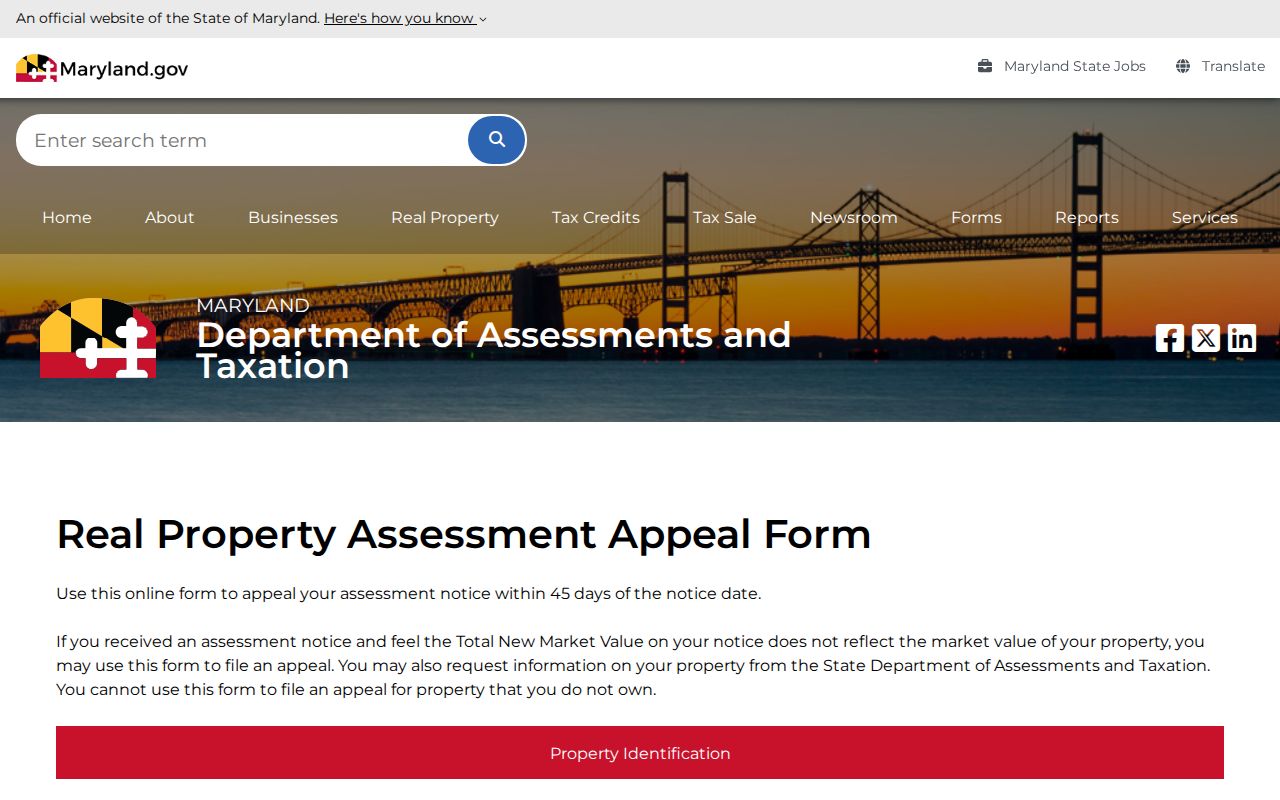
The form shows why the notice matters. County, notice number, and control number are the filing keys for any Baltimore County appeal.
Appeal window. File within 45 days of the assessment notice date. Missing that deadline can close the ordinary notice appeal route for the cycle.
Online Baltimore County records cannot answer every administrative question. The Maryland Public Information Act route fills that gap. A request should carry the full situs address, SDAT account, tax map, grid, parcel, Tax ID, bill number, or case number. Inspection is generally free. Authorized search, preparation, and reproduction costs may apply, and a PIA request does not alter a bill or extend an appeal deadline.