
Baltimore County Deed Chain Timeline
Begin with the liber and folio shown in SDAT for the current owner of record. From there, add a row for each earlier transfer. That keeps former owners, dates, deed types, and references in order. Be careful with city directories. A person listed as an occupant is not the owner of record. A deed or a related court instrument must back it up.
| Transfer Date | Grantor to Grantee | Deed Type | Book/Page |
|---|---|---|---|
| Newest recording | Seller to present grantee | Copy exact instrument type | SDAT or MDLandRec reference |
| Prior recording | Earlier seller to later grantor | Deed, trustee, fiduciary, or other transfer | Prior reference from deed |
| Earlier book | Indexed parties matched to the same land | Copy the record wording | Historic liber/folio |
| Patent or tract origin | Original or early parties | Patent, lease, assignment, or conveyance | Archives series locator |
The county publishes no exact modern electronic cutoff date. Keep that gap visible in your chain. MDLandRec carries the current searchable index, and Maryland State Archives finding aids, microfilm, land books, and tract indexes take over when the online trail stops.
Baltimore County Records Since 1659
Maryland State Archives Series C352 covers Baltimore County court land records from 1661 through 1851. Related descriptions and microfilm reach back to 1659. The holdings run from deeds and mortgages to releases. They also include leases, assignments, easements, and powers of attorney. Grantor, grantee, and tract indexes each open a different door. Later finding aids bridge the shift. Circuit Court land-record indexes span 1851 through 1921 in identified series. The original grantor-index finding aid reaches 1992. Those are archival coverage statements, so check today's MDLandRec county index for the rest.
Online cutoff not verified. No official source gave the exact modern Baltimore County cutoff. Older former owners may require microfilm, deed books, and Archives indexes.
Reconstruct Baltimore County Ownership Backward
Read each deed fully before hunting the next name. The prior book and page reference, or a "being the same property" clause, often beats a surname for reliability. When no prior reference appears, search the grantee index for the date the seller first acquired the land.
- Find the present deed through SDAT's liber/folio and MDLandRec.
- Transcribe grantor, grantee, legal description, consideration, date, and prior reference.
- Open the prior reference or search the grantor as a grantee, then confirm the same acreage, lot, tract, and adjoining land.
- Repeat until the electronic trail ends, then continue in Archives indexes, microfilm, and deed books.
- Grantor
- The party conveying a recorded interest.
- Grantee
- The party receiving that interest.
- Chain of title
- The ordered sequence of instruments affecting the same land.
- Reverse index
- An index organized by grantee, useful for finding an owner's acquisition.
- Quitclaim and warranty deeds
- Different forms of conveyance whose exact effect must be read from the instrument.
Baltimore County Name Variants
MDLandRec name search offers Is, Begins With, Ends With, Contains, Fuzzy, and Soundex modifiers. You can also filter by grantor or grantee role. Legal capacity, instrument type, dates, and remarks can be filtered too. Enter corporation names exactly. Test spelling variants for individuals. A shared name proves nothing about the parcel. Match legal description, acreage, tract, lot and block, prior reference, roads, streams, and adjoining owners. A nineteenth-century deed may carry no modern street number at all.
Baltimore County Plats Extend the Chain
PLATS.NET holds subdivision, condominium, right-of-way, road, division, patent, and historic plat series. Search by book and page, plat or box, date, description, clerk initials, or series. A plat can tie a former tract to later lots. It also exposes adjoining owners. Plat Book C2122 spans 1804 through 1993. Other Baltimore County series run from 1600s patents to road plats in the 2000s. Use the deed and survey evidence beside the map. A drawn line alone does not decide title.
Baltimore County Estate Transfers
A death can break a clean buyer-to-seller chain. The deed may name a trustee, executor, personal representative, heirs, or a life tenant. Match that fiduciary capacity against the Register of Wills or Orphans' Court file. Also check death proof where required. Maryland's unclaimed-property KAPS system launched in October 2025. It can surface an heir or former-owner lead. It never replaces a deed or probate order. For the ownership conclusion, return always to the recorded land instrument.
Local Clues for Baltimore County Chains
Baltimore County Public Library databases include Baltimore newspapers, genealogy products, and local-history help. Notices, directories, obituaries, and historic surveys can explain a former owner's name, a street change, a subdivision launch, or an executor. The Winters Lane history of Catonsville is especially useful. Its trail runs from turnpike and leasehold land through an 1854 subdivision, rail service, streetcars, and later suburban lots. East Towson and older Dundalk areas hold their own tract and plat clues. Use that context to refine a deed search, never as proof of title.
Access Baltimore County Historic Deeds
Several online routes reach Baltimore County deed records. MDLandRec, Archives guides, PLATS.NET, and library databases all help, though remote MDLandRec page images now require an account and payment after the Fall 2025 release. Free access is available at Archives, courthouse, and law-library workstations.
For help, call the clerk's land index desk at 410-887-3088 or the recording desk at 410-887-2651 with the county, volume, page, name, and date. Archives and BCPL local-history staff can help you prepare for an in-person visit. A PIA request covers county administrative records only; it does not replace a search of the Archives collection.
Baltimore County MDLandRec Access
The MDLandRec account screen is the remote entry point for Baltimore County deed indexes and page images.
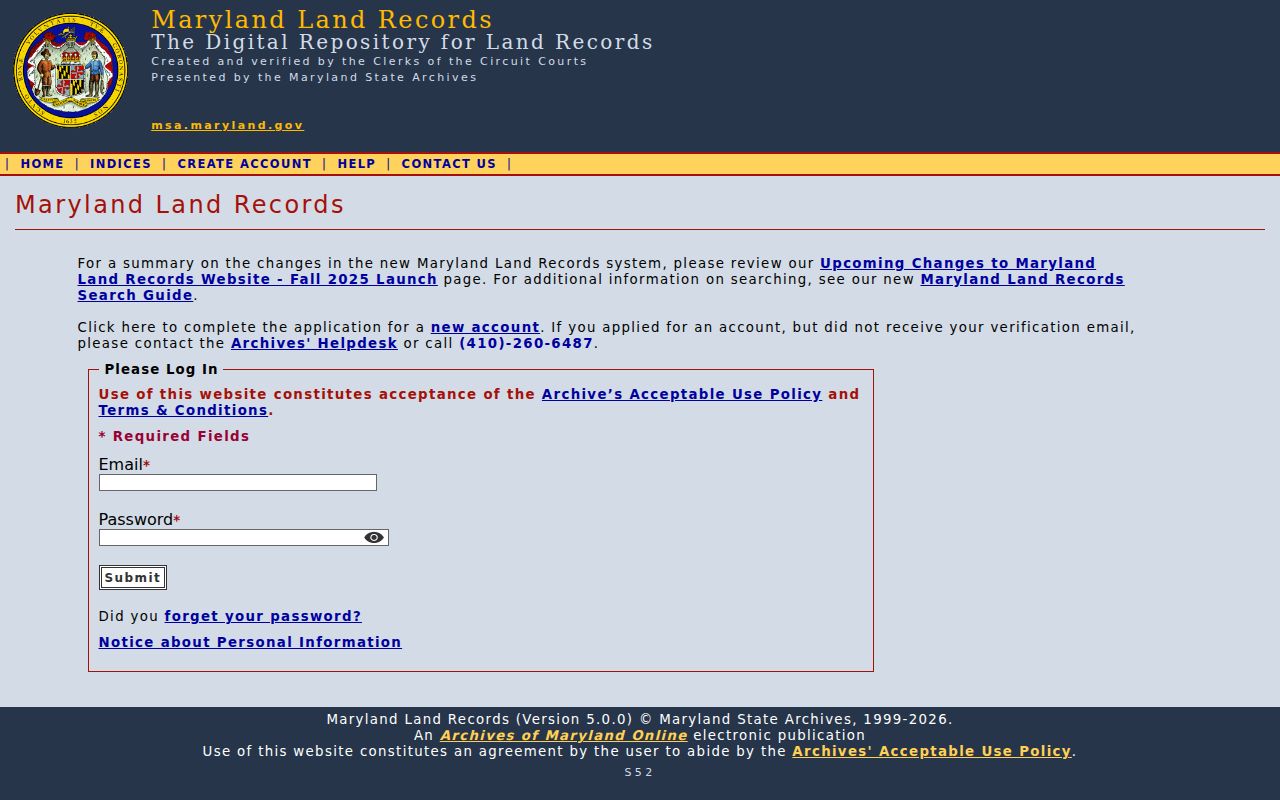
That account gate explains why the free courthouse and Archives workstations still matter. They remain the practical fallback when a chain of previous owners runs long.
Depth of Baltimore County Ownership Records
Baltimore County land evidence reaches into the seventeenth century through Archives series. Not every parcel will yield an unbroken chain back to a patent, though. Missing cross-references and spelling shifts are common. So are "part of" descriptions, leaseholds, estates, and changed roads. These problems often force tract and adjoining-owner research. No official source records a courthouse fire that erased any stated run. So do not invent a lost-record event.
Lawful use. Former-owner research supports house history, estates, and land diligence. Never use historical records to track, harass, threaten, or harm a living person.
The Baltimore County deed records page explains how to pull a single deed. This page works differently. The goal here is to walk backward from one proved transfer. The target is the one before it. Each step should rest on evidence, not guesswork.
A similar surname is only a lead. So are neighboring tracts, directory listings, and newspaper sale notices. Evidence looks different. A deed reference that matches proves a link in a Baltimore County property records chain. So does a paired legal description. Tag every uncertain connection with the reason it stays tentative. That habit keeps a former-owner timeline honest even before the earliest transfer is proved.
Older instruments carry vocabulary that resists modern templates. Expect patents, leaseholds, ground rents, releases, dower rights, life estates, and trustees. Copy each term exactly as written. Then work out its effect from the document itself. Add the law that applied at the time. Forcing an archaic conveyance into a modern sale pattern invites error. Transfer form often explains why a former owner of record shows up in one index role. It may not be the one searched first.
Remote and onsite research serve different purposes. MDLandRec delivers a known book and page within seconds. An Archives finding aid can surface a tract, grantor, or series. A modern address search never reaches those. Courthouse workstations matter when remote images sit behind a gate. Bring a narrow list of names, years, and references. A request for everything at once usually yields nothing useful.