
Baltimore County Property Value Types
SDAT lists several value fields on each parcel card. Land and improvements are tracked separately. Total assessment combines the two, while phase-in assessment shows Maryland's staged rollout of a new appraisal. Sale Price is deed consideration from the recorded transfer, and its transfer type decides how well the number works as a comparison.
| Value | What It Is | Where |
|---|---|---|
| Land assessment | SDAT's value component for the land | SDAT parcel result |
| Improvement assessment | Value component for structures and improvements | SDAT parcel result |
| Total and phase-in | Combined assessment and amount applied during phase-in | SDAT parcel result |
| Recorded sale price | Consideration reported with a deed transfer | SDAT sale history and deed |
A tax bill is not another estimate of market worth. It applies rates, exemptions, and credits to the assessment on record. For bill mechanics and appeal details, turn to the Baltimore County property tax records resource.
Read Baltimore County Assessment Fields
The SDAT Real Property Search returns Assessment Year, Land, Improvements, Total, and Phase-In Assessment. Land Use, Quality, and Property Land Area add shape. Lot and section references, municipal and special-tax-area flags, principal residence, and pending improvement notices add further context. A pending permit flag is a clue, not proof. Homestead Application Status, Homeowners' Tax Credit status and date, Partial Exempt Assessments, and Preferential Land can explain why taxable outcomes differ even when gross values sit close. Keep Mailing Address and Premises Address apart. Neither changes the value directly. Confusing the two can quietly attach a comparison to the wrong parcel number.
Check a Baltimore County Property Value
Anchor any comparison to the parcel's identity. SDAT requires Baltimore County plus a search method. It accepts a premises address, street, account identifier, or map reference. Owner name, town, ZIP, neighborhood, and subdivision are not search options, and the account identifier is the strongest route once you have it.
- Choose Baltimore County in SDAT and locate the parcel by premises address, account, or map reference.
- Record the assessment year plus land, improvement, total, and phase-in figures.
- Read sale date, price, parties, and transfer type before treating the sale as a comparison.
- Confirm the deed through its liber and folio when consideration or parcel scope is unclear.
- Total assessment
- The combined land and improvement value maintained by SDAT.
- Phase-in assessment
- The staged assessment figure used within Maryland's cycle.
- Sale consideration
- The price stated for a recorded transfer, subject to its transfer type.
Baltimore County's Three-Year Cycle
Maryland reassesses real property by area on a three-year schedule. Baltimore County parcels can also receive quarter, half, three-quarter, or full-cycle treatment. That applies to new construction or other out-of-cycle changes. Assessment Year shows which cycle applies. Do not confuse it with the purchase date. A sale can land between reassessment points. Local conditions may shift after the assessment date. SDAT data updates daily. That refresh does not remake the appraisal behind it. Compare the dates on the record before calling any value current.
Note: Daily portal updates and the three-year appraisal cycle describe different parts of the record.
2025 Baltimore County Value Ratios
The 2025 assessment-ratio survey reported median sale ratios of 91.1 percent for residential property, 85.3 percent for commercial property, and 91.1 percent for agricultural property. Use value came in at 100 percent. The weighted overall median was 89.5 percent. A ratio compares assessed values with qualifying sales across an entire class. It is not a formula for one address. These numbers work best as quality-control context. They explain why a countywide assessment should not be read as a precise offer price. Parcel traits, valuation date, transfer quality, and local market evidence still control how any single Baltimore County property value reads.
Baltimore County Sale Price Context
SDAT lists Sale Date, Sale Number, Price, Sale From, Sale To, and Sale or Transfer Type for qualifying transfers. The glossary separates Arms-Length Improved, Arms-Length Multiple Accounts, Arms-Length Unimproved, and Non-Arms-Length Other. A multi-account transfer splits one price across parcels. Family, estate, trust, and related-party deeds may be non-arm's-length. Sale Date in the assessment record is the deed recording date. It is not necessarily the signing or settlement date. Confirm the latest instrument in MDLandRec. The deed itself names the legal description, consideration, parties, and prior reference you need to judge whether a sale fits the parcel.
Baltimore County Credits Change Taxes
Homestead and Homeowners' Tax Credit fields can change the taxable outcome. So can principal-residence status, partial exemptions, preferential land, and special tax areas. None of these creates a second market value. Two nearby parcels can share one total assessment. Their bills can still differ. The county tax portal accepts a Parcel ID or Street Address. It presents bill details in a dynamic session. Check that source for charges, credits, rates, fees, and payment status. The division of labor stays firm: the tax portal owns the amount billed. SDAT owns the assessment components behind the value.
Appeal a Baltimore County Assessment
An assessment notice generally opens a 45-day appeal window. The Maryland assessment appeal form asks for the county, notice number, and control number. It also warns that the owner must file. Keep the notice handy. Strong evidence ties directly to the valuation date and the property: corrected characteristics, relevant sales, deed facts, or a documented condition. A recorded price alone may carry little weight if the transfer was non-arm's-length or spanned several accounts. Call the SDAT Baltimore County office at 410-512-4900 with assessment questions and current procedure. The appeal portal opens with three required fields.
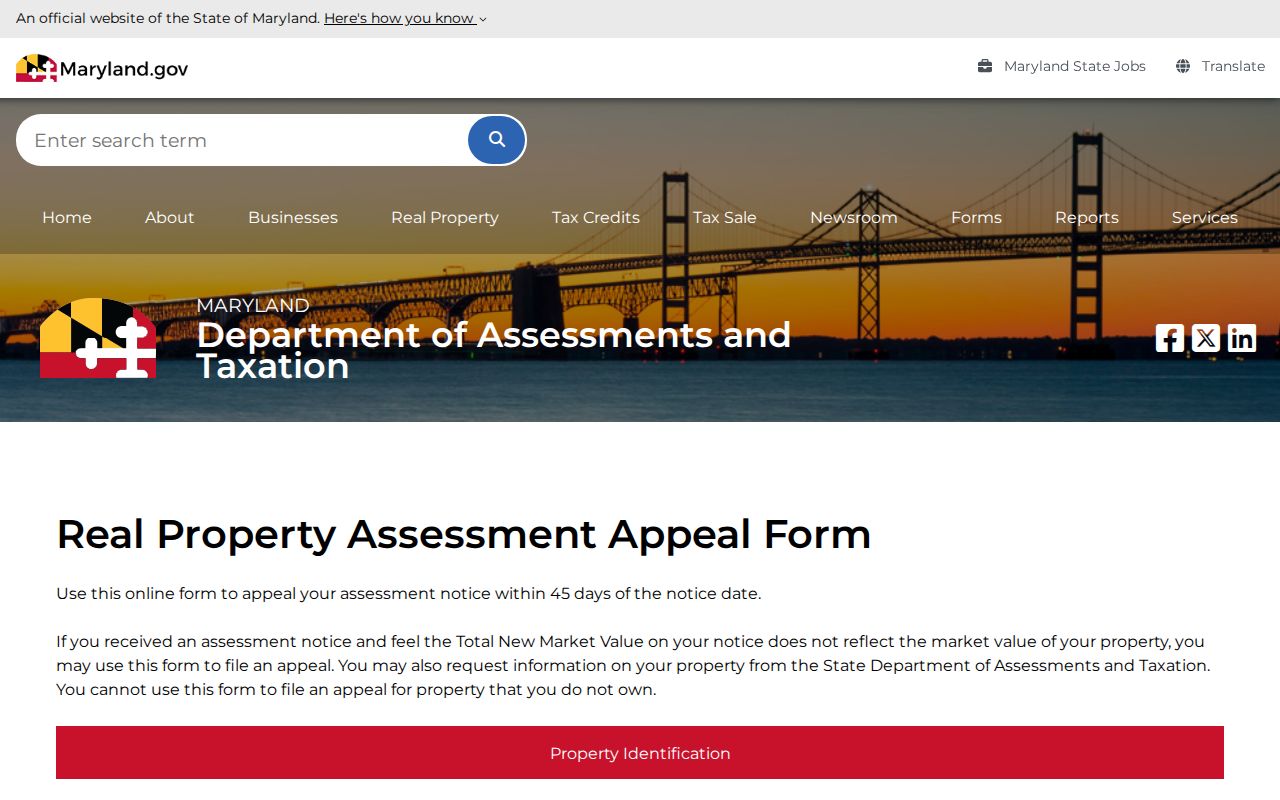
Notice and control numbers set appeals apart from ordinary lookups.
Baltimore County Property Value Limits
An SDAT assessment in Baltimore County is an administrative value. Maryland uses it to set property taxation, nothing more. It is not a licensed appraisal. It cannot serve as a title opinion, a sales offer, or a forecast of proceeds. A total-value field in the county GIS map simply repeats property records data inside a spatial service. Treat it as a copy of the assessment rather than an independent valuation of the parcel.
Value versus price. A Baltimore County assessed value does not state what a property will sell for. Obtain a licensed appraisal when a transaction needs a current market opinion.